
JCT Explains…Interim Payments
In this feature for JCT News, we break down some of the key sections and clauses within the JCT contract to explain and provide more information about how these elements function in practice. The issue looks in more detail at the process of interim payments.
Interim payment procedure under the JCT Standard Building Contract 2024
Generally, the provisions relating to valuation, certificates, notices and payment (interim and final) are the same or similar for many of the JCT main and sub-contracts. In this article, we refer to the JCT Standard Building Contract 2024 (SBC).
SBC includes detailed provisions for payment as the works progress. The payment cycle is based on the issue of interim certificates on a monthly basis. The payment provisions are contained in section 4 of the contract form.
Due dates for interim payments
SBC starts by defining the due dates for interim payments, which under the Construction Act must be fixed. For the period up to the due date for the final payment, the monthly due dates for interim payments by the employer are in each case the date 7 days after the relevant ‘Interim Valuation Date’ specified in the contract particulars.
The Interim Valuation Date system
The concept of interim valuation dates (IVD) was introduced in the 2016 edition of JCT contracts in support of the government’s 2014 Construction Supply Chain Payment Charter. The Charter has since been withdrawn and replaced by other government actions and initiatives aimed at ensuring certainty of payment and fair payment practices within public body supply chains.
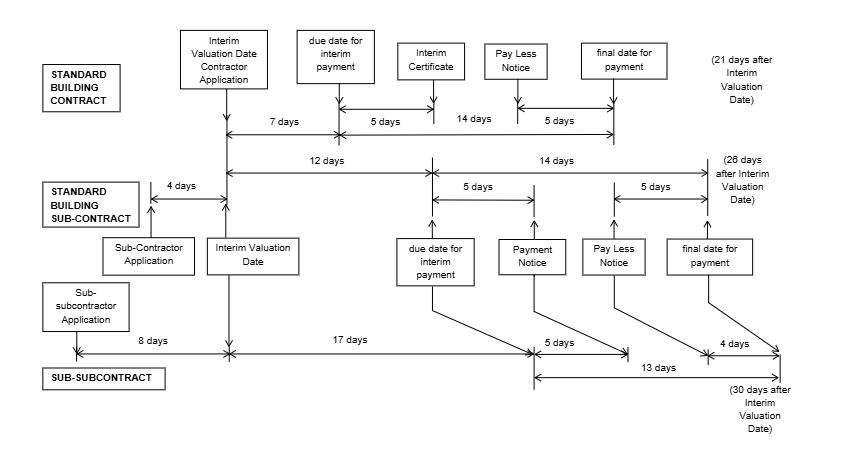
JCT’s IVD system is designed to streamline the payment process across the contractual chain, to allow for interim payments at main contract level and downstream to be assessed on the same date each month and paid shortly thereafter.
In SBC the system works by requiring the parties to specify the first IVD in the contract particulars. JCT recommends that the first IVD is not more than one month after the date of possession. Should the parties fail to agree on a date, a default date is provided for in the contract particulars, which is one month after the date of possession. Subsequent IVDs are then the same date in each month, or the nearest ‘Business Day’ in that month. (Employers and (in relation to sub-contracts) contractors should take careful note of the fact that the IVD is capable of being adjusted because any alteration in the IVD will directly affect the due date and, amongst other things, the 5 day period for issue of the interim certificate, the last date for giving a pay less notice and the final date for payment.)
The payments can be streamlined between tiers by using JCT sub-contracts and sub-subcontracts which provide for the IVD under the main contract to apply to the payment process under the sub-contract/sub-subcontract.
The payment provisions are designed to have payment periods not exceeding 30 days, so as to conform with fair payment principles. The system is demonstrated in the following diagram.
Interim certificates and valuations
The architect/contract administrator is required to issue an interim certificate within 5 days of the due date, this being the maximum period allowed under the Construction Act (clause 4.9 of SBC) stating the sum it considers to be or have been due to the contractor at the due date, calculated in accordance with clauses 4.14 and 4.15. Clause 4.14 sets out the ‘Gross Valuation’ rules for interim payments, i.e. the basis for calculating amounts that have fallen due under the contract. The Gross Valuation is calculated as at the Interim Valuation Date (clause 4.14). Certain deductions are made against the Gross Valuation figure under clause 4.15, e.g. any amount that is to be retained by the employer under the retention provisions.
The quantity surveyor is responsible for preparing interim valuations whenever the architect/contract administrator considers them necessary for ascertaining the sum due in an interim certificate (clause 4.9).
SBC makes it clear that an interim certificate is not of itself conclusive evidence that work is in accordance with the contract (clause 1.10). Under clause 4.15, the part of the gross value for work executed is for the value of work ‘properly executed’, but the interim payment mechanism has to allow for the fact that as the work progresses things may change, and sums included in an earlier certificate, e.g. for works and materials may be omitted in a later one.
Interim payments – contractor’s payment applications, payment notices and pay less notices etc.
In relation to any interim payment, the contractor may not later than the interim valuation date make an application to the quantity surveyor stating the sum that the contractor considers to be due at the due date and the basis on which that sum has been calculated (clause 4.10.1).
The payment provisions then set out the default mechanism that is provided for by section 110B of the Construction Act. In default of an interim payment certificate being issued, they deal with the role of the contractor’s payment application as a payment notice: [Please amend below to bulleted paragraphs.]
- If the contractor makes a payment application no later than the interim valuation date in accordance with clause 4.10.1 and there is no interim certificate by the required time, the contractor’s payment application is deemed to be a payment notice (clause 4.10.2.1).
- Where the contractor has not made a payment application, it may at any time after the last date for issue of the interim certificate give a payment notice to the quantity surveyor stating the sum that the contractor considers to have become due to it under clauses 4.14 (Gross Valuation) and 4.15 (sum due) at the relevant due date and the basis on which that sum has been calculated (clause 4.10.2.2) and (as required under the Construction Act) the final date for payment will be postponed by the number of days after the last date for issue of the interim certificate that the payment notice is given.
The contract states that the final date for payment of each interim payment is 14 days from its due date (except where the date is postponed under the default payment notice provisions referred to above). If the employer intends to pay less than the sum stated as due in an interim certificate or payment notice, it must not later than 5 days before the final date for payment, notify the contractor, in a ‘pay less notice’, of the sum the employer considers to be due on the date the notice is served and the basis on which this sum has been calculated (clauses 4.11.5 and 4.12). The timescale for issuing the pay less notice is short and the employer will need to act promptly if it believes it should pay less than the amount stated in the certificate or payment notice.
If there is no pay less notice within the stated time period, the employer must pay the sum stated as due in the interim certificate or payment notice by the final date for payment. Failure to do so would constitute a breach of contract, and there will be a number of remedies available to the contractor.
The contractor is entitled to interest in the event of the employer’s failure to pay the whole or part of the sum due as an interim payment (clause 4.11.6). Interest is payable at 5% above the official bank rate of the Bank of England current at the date that the payment becomes overdue payable from the final date for payment until payment is made.
The contractor’s right of suspension for non-payment under clause 4.13 of SBC reflects the requirements of the Construction Act. The clause provides that if the employer fails to pay a sum payable to the contractor in accordance with clause 4.11 by the final date for payment and that failure continues for 7 days after the contractor has given notice to the employer, with a copy to the architect/contract administrator, of its intention to suspend performance of its obligations and the grounds of the proposed suspension, the contractor may suspend performance of any or all of its obligations under the contract until payment is made in full. This right does not affect any other rights or remedies the contractor may have. The contractor has the right to claim costs and expenses reasonably incurred as a result of the suspension.
In practice (and as an alternative), consideration may be given to starting adjudication proceedings, as suspension causes considerable disruption to work.
Failure by the employer to pay the amount due in accordance with clause 4.11 by the final date for payment is a specified default ground under the provisions providing for termination by the contractor of its employment in section 8 of the form (SBC, clause 8.9).
In practical terms when faced with non-payment contractors should take a structured approach and consider options and any steps carefully. If there is any doubt as to any steps to be taken, professional advice should be sought.
The information in this article is adapted from JCT Contracts Discovery 2026. The process of payment is also one element covered in the range of JCT Training courses and resources. www.jctltd.co.uk/jct-training